

ClawBox 4.0
The fourth release turns the box from an assistant you talk to into one that also does the work: it writes code in your repositories and opens pull requests, it keeps one address you can reach from anywhere, it backs itself up, and it fits on a phone screen.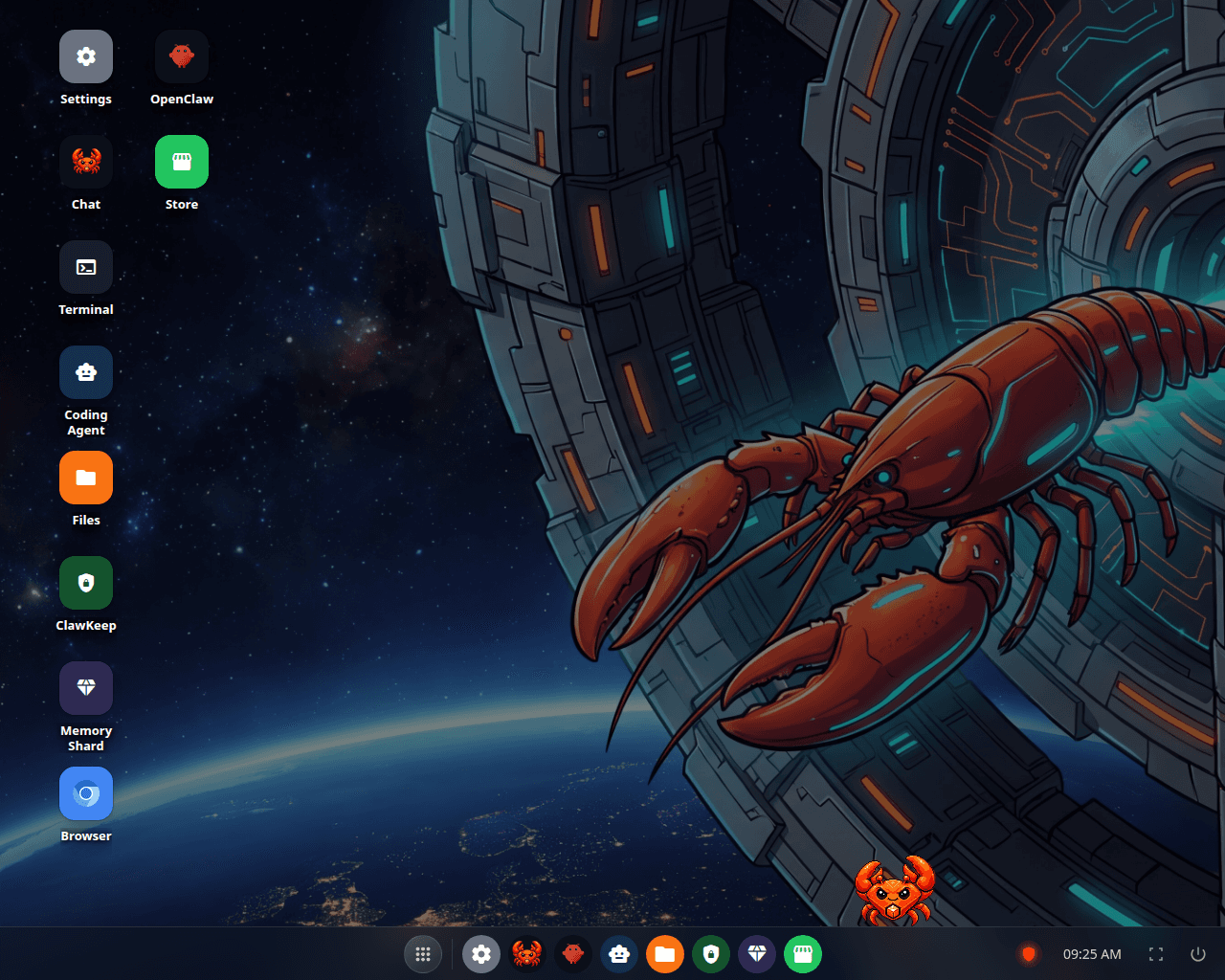
The 4.0 desktop, once setup is done and nothing is left to ask you
A coding agent that does the whole job
Coding Agent on the desktop hands a whole task to Claude Code running on this box. Point it at a folder, describe the job, and it reads and writes files there, runs commands, and reports what it did. Each attempt is a run, kept with its own page: the task, the folder, who asked for it, how long it took, how many steps it took, the files it touched, the models it used, and the final summary. The runs list keeps the recent runs in front of you and refreshes itself every few seconds while one is live. The box keeps the last 30 runs: a run that is live, paused or drafted is never dropped, and once there are more than 30 the oldest finished one falls off the end.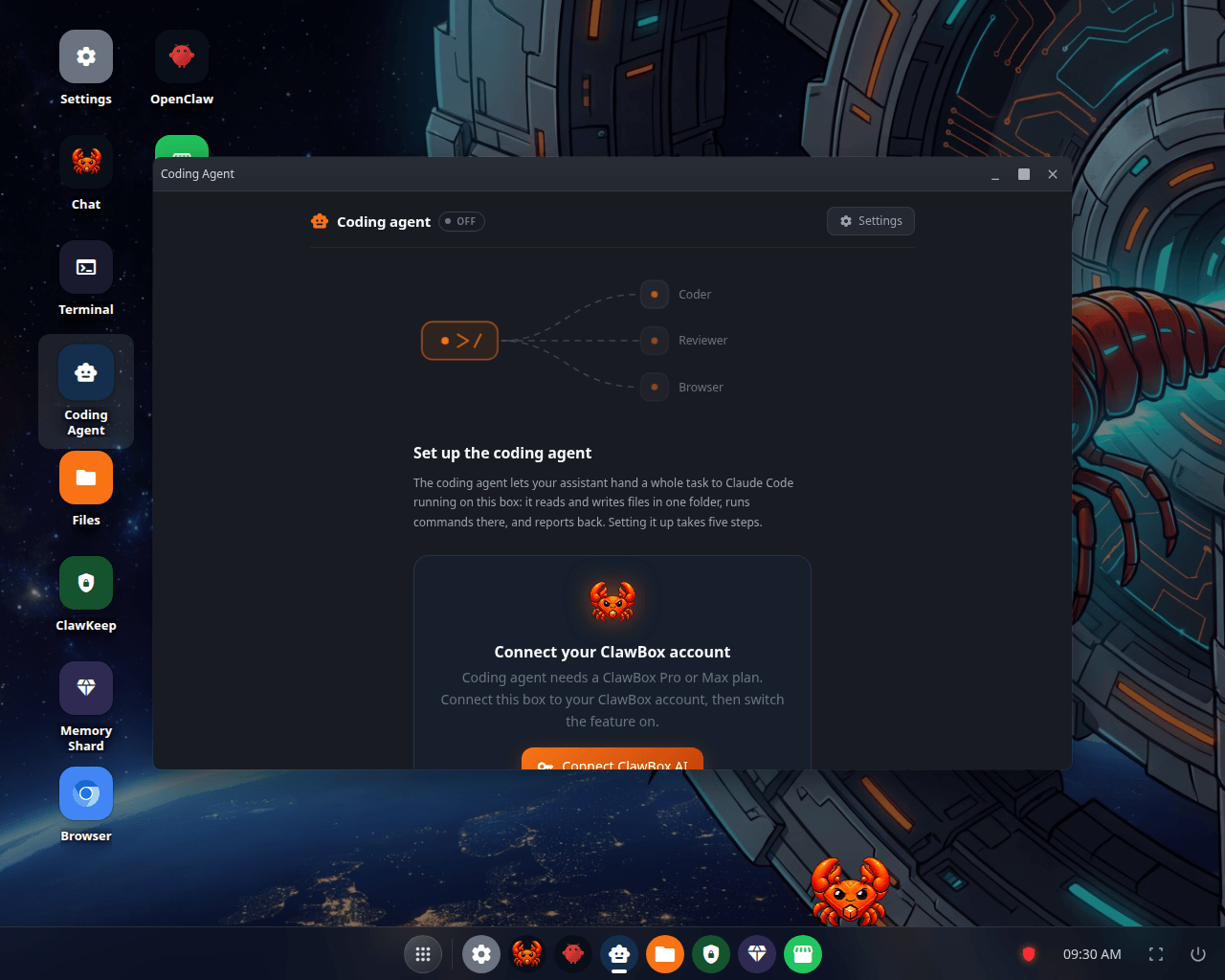
Coding Agent on a box that has not set it up yet: it wants a plan on your account first
Runs open pull requests, and review their own work
With the auto-PR switch on, a run that changes files in a git repository pushes its own branch and opens a pull request for it. The run’s page carries the pull request number, its title and its state, so you do not have to go looking on GitHub. With the review switch on, a completed run is followed by an automatic review pass: a second run that reads the first one’s work and reports what is wrong with it. The review is a run of its own, linked to the one it reviewed. When a pull request comes back with comments, or its checks fail, the agent can work the feedback in rounds until the thread is clear.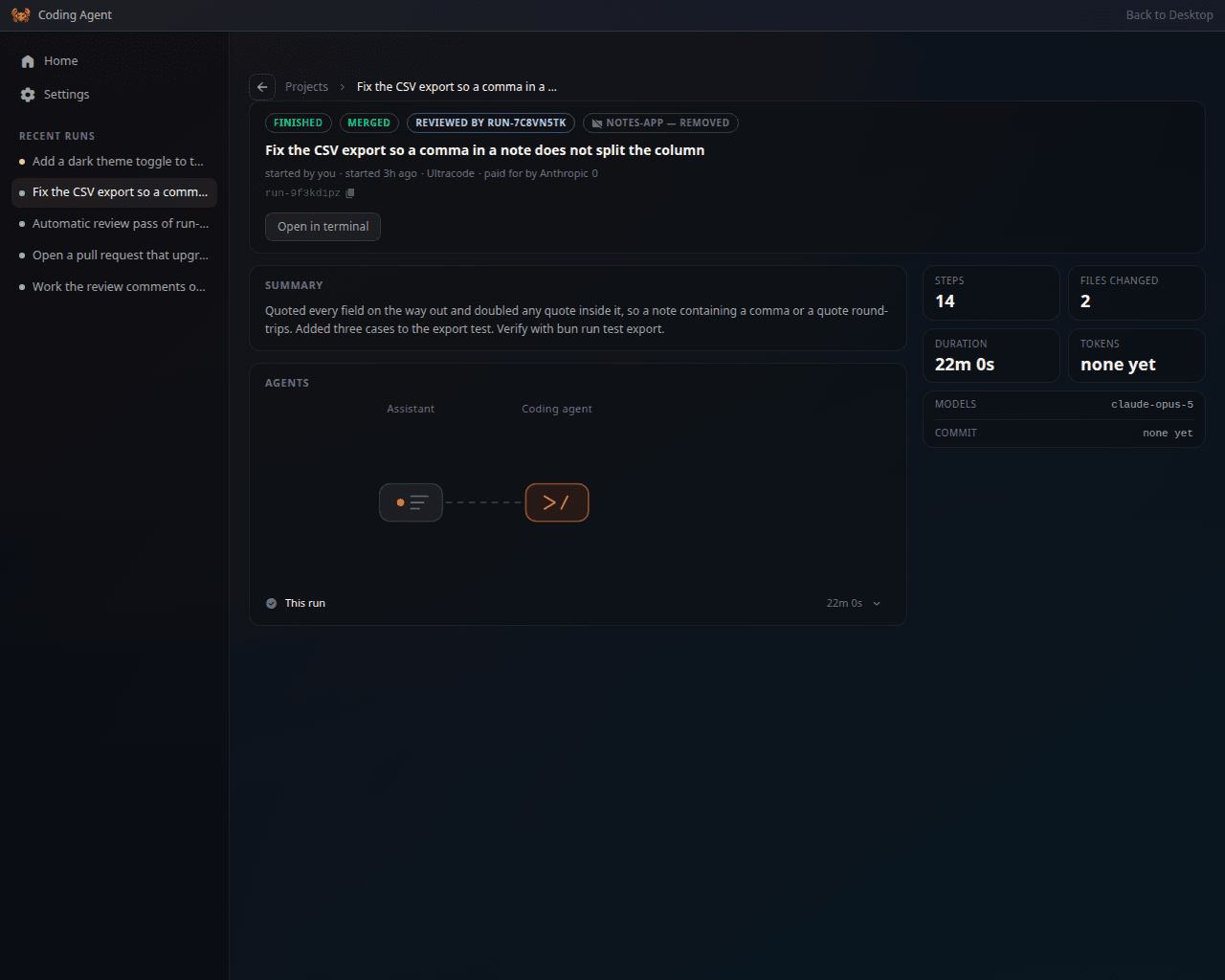
A finished run: the pull request is merged, and a review pass links back to it
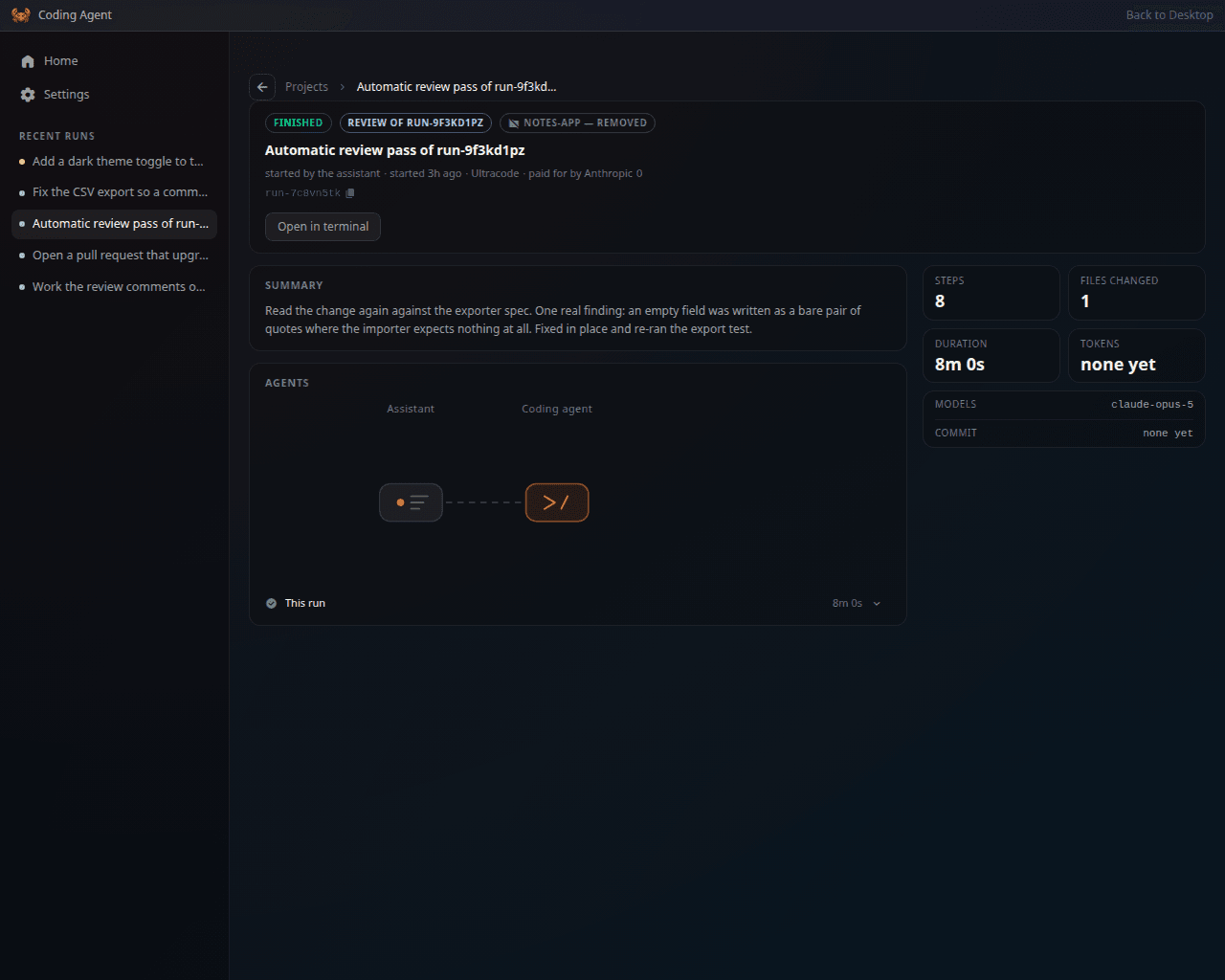
The review pass itself, a run of its own that reads the work of the run before it
More than one Anthropic account for coding runs
Settings → Providers → Anthropic accounts now holds several Claude Pro/Max accounts and API keys, in the order you choose. When the account a coding run is using hits its usage limit, the run moves to the next account and continues in the same session. Your first account takes over again as soon as its limit resets. If every account is limited, the run waits and resumes by itself at the first reset. Every move is recorded on the run’s page, so you can see which account paid for which part of the work. See Multiple Anthropic Accounts.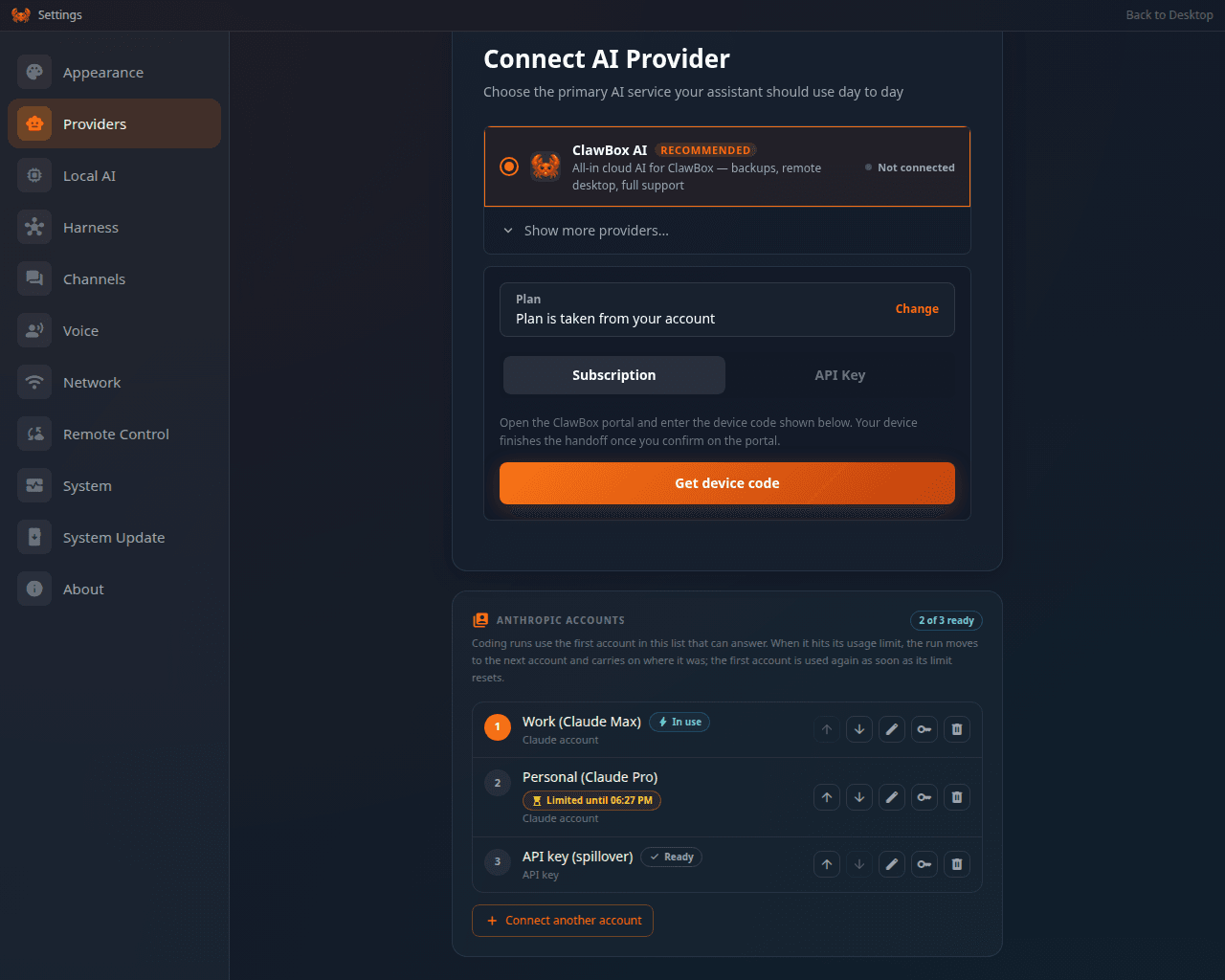
Settings → Providers → Anthropic accounts, with one account set aside until its limit resets
Watch a long task from the chat
A task that takes a while now shows a progress card in the chat, pinned between the conversation and the message box. It names the step the assistant is on, counts the steps that are done against the total, says when it last moved, and carries the assistant’s own note about what it is doing. Fold it away and it stays folded, on every chat surface, until you open it again.A terminal on the box
Terminal is a real terminal, not a log viewer. It connects to a shell on the box, so you can type commands, run a build, and watch it work. It has tabs, copy and paste, a right-click menu, and settings for the font and the colours. Where the browser offers WebGL it draws through the GPU, so the text stays sharp on a high-density screen, and where it does not the terminal falls back to drawing in the page.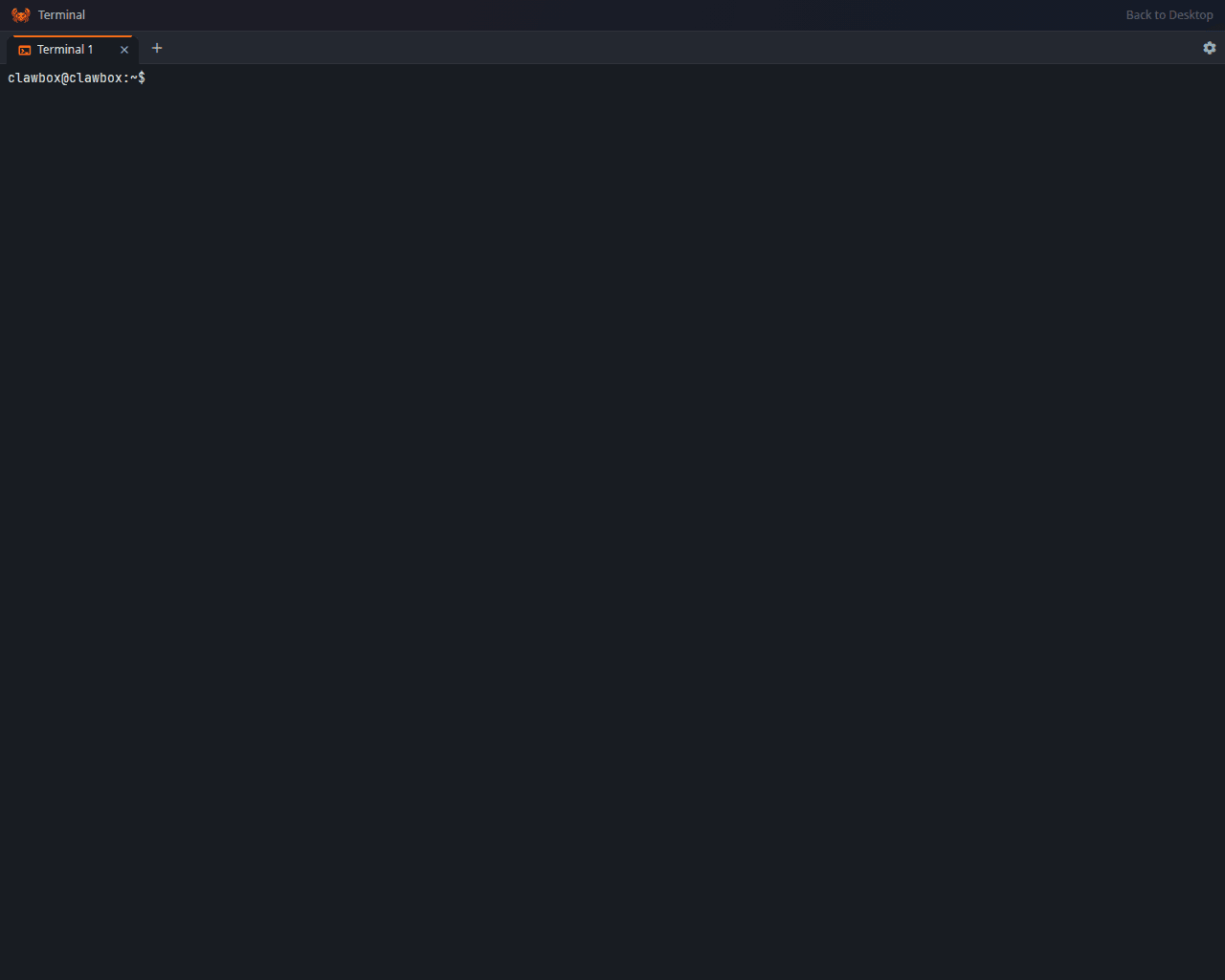
The Terminal app, with its own tabs and a shell on the box
Steer a run while it is running
The assistant can now drive the coding agent through its own tools: start a run, read its state, resume it, list the projects it knows about, and send a message into a run that is already going. So you can change your mind mid-task from the chat, or from Telegram, without stopping the run and starting again. The same tool set reads Memory Shard, Local AI and your ClawBox AI usage.Your box keeps one address
A box linked to your portal account gets a permanent address of its own, of the form<your-box>.clawbox.tech, and runs a named Cloudflare tunnel to serve it. The address
does not change when the box reboots, when the tunnel restarts, or when your home IP
moves, so a bookmark keeps working and the address is worth writing down.
The old quick tunnel is still there as the fallback, with its long random
trycloudflare.com address, for a box that has no named tunnel yet. Both live in
Settings → Remote Control. See Networking.
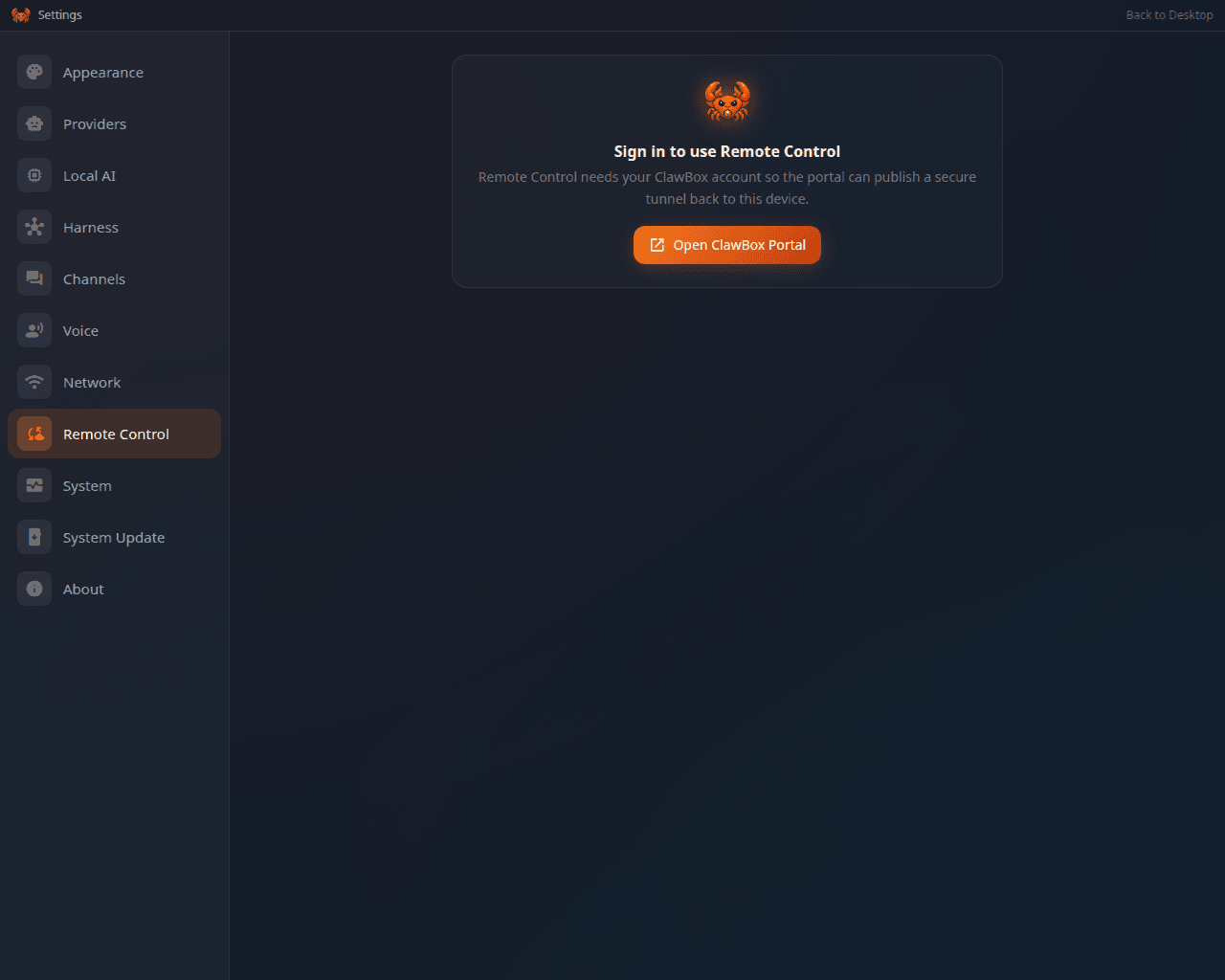
Settings → Remote Control, where the box's address is turned on and off
Switch your box between OpenClaw and Hermes
A box that shipped as one edition can now be re-made as the other from Settings → Harness, without a reflash and without a second box. The button installs the other agent, re-bakes the edition lock, carries your ClawBox AI sign-in, your Telegram bot and your memory folders across, and reloads the desktop. The same button swaps back. It needs the Max plan, an internet connection and about 3 GB of free disk. Staying on the harness your box already runs costs nothing. See Switching editions.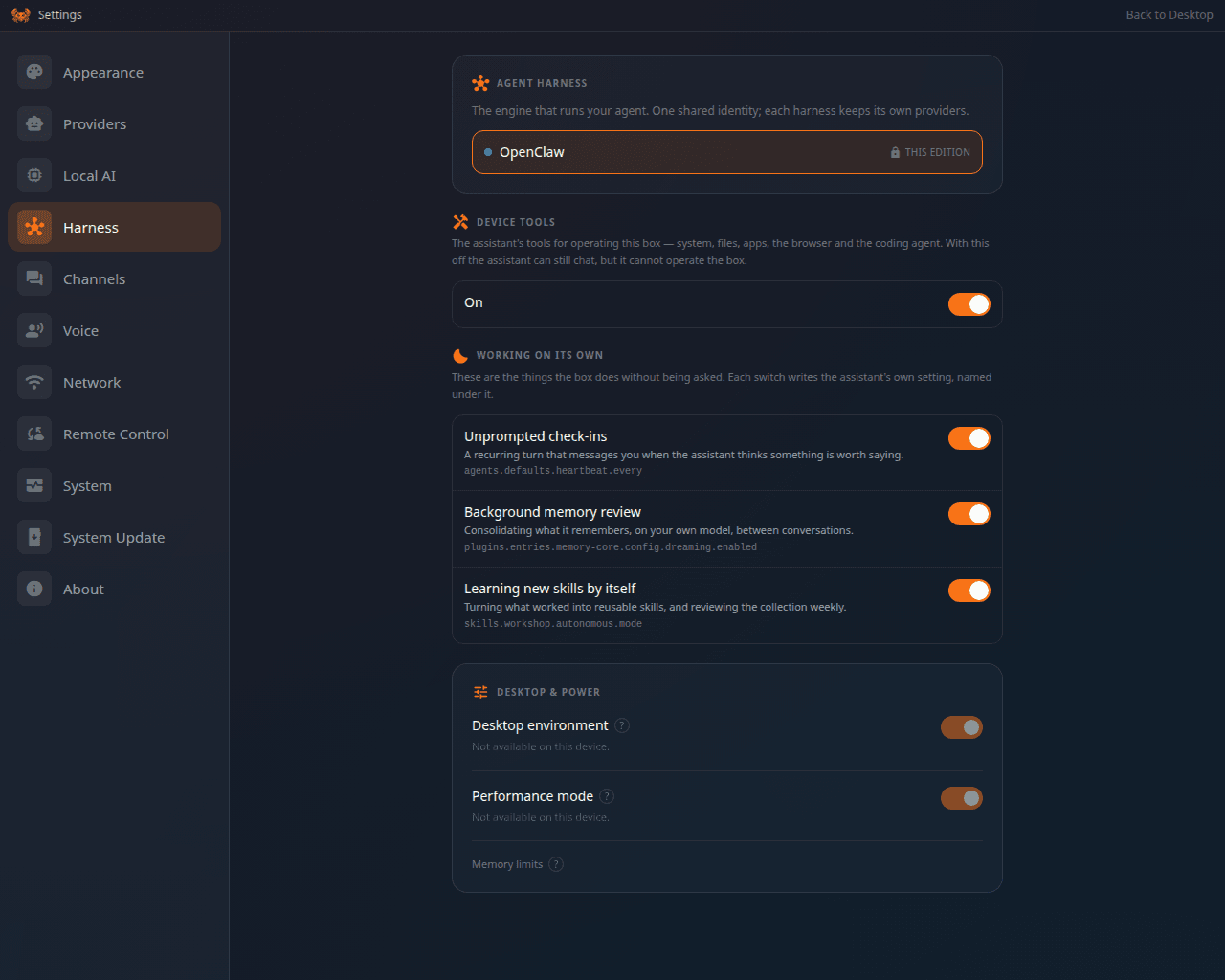
Settings → Harness: the engine the box runs, and the button that swaps it
ClawBox AI runs on DeepSeek V4
ClawBox AI has two models and your plan picks one. Free/Pro Tier is DeepSeek V4 Flash, the default and the faster of the two. Max Tier is the 1.6T frontier model and needs the Max plan. Both take a one-million-token context window and both are text in, text out. You do not have to choose a model on ClawBox AI: the chat names the provider and the plan decides the rest. See ClawBox AI.ClawKeep backs the box up
ClawKeep on the desktop takes your agent’s state, its configuration, its credentials and its saved conversations, and keeps them off the box. Pair it once with your account and it can back up on a schedule or when you press the button, hold several snapshots, and restore any of them onto this box or a replacement. The archive can be encrypted with a passphrase only you hold. Its card says when the last backup ran, how much cloud space you are using, and how many snapshots you have.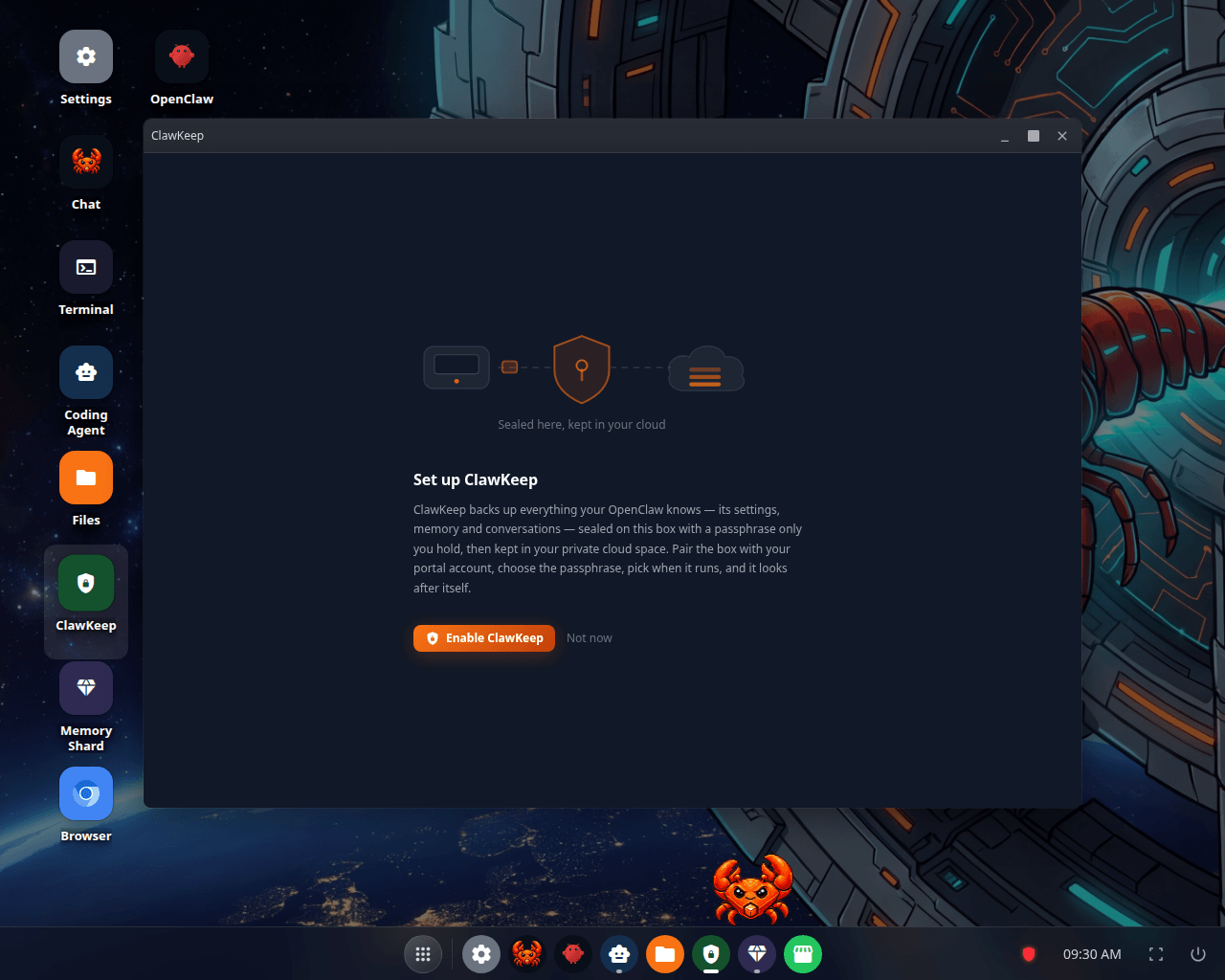
ClawKeep on a box that has never backed up: what it covers, and the button that starts it
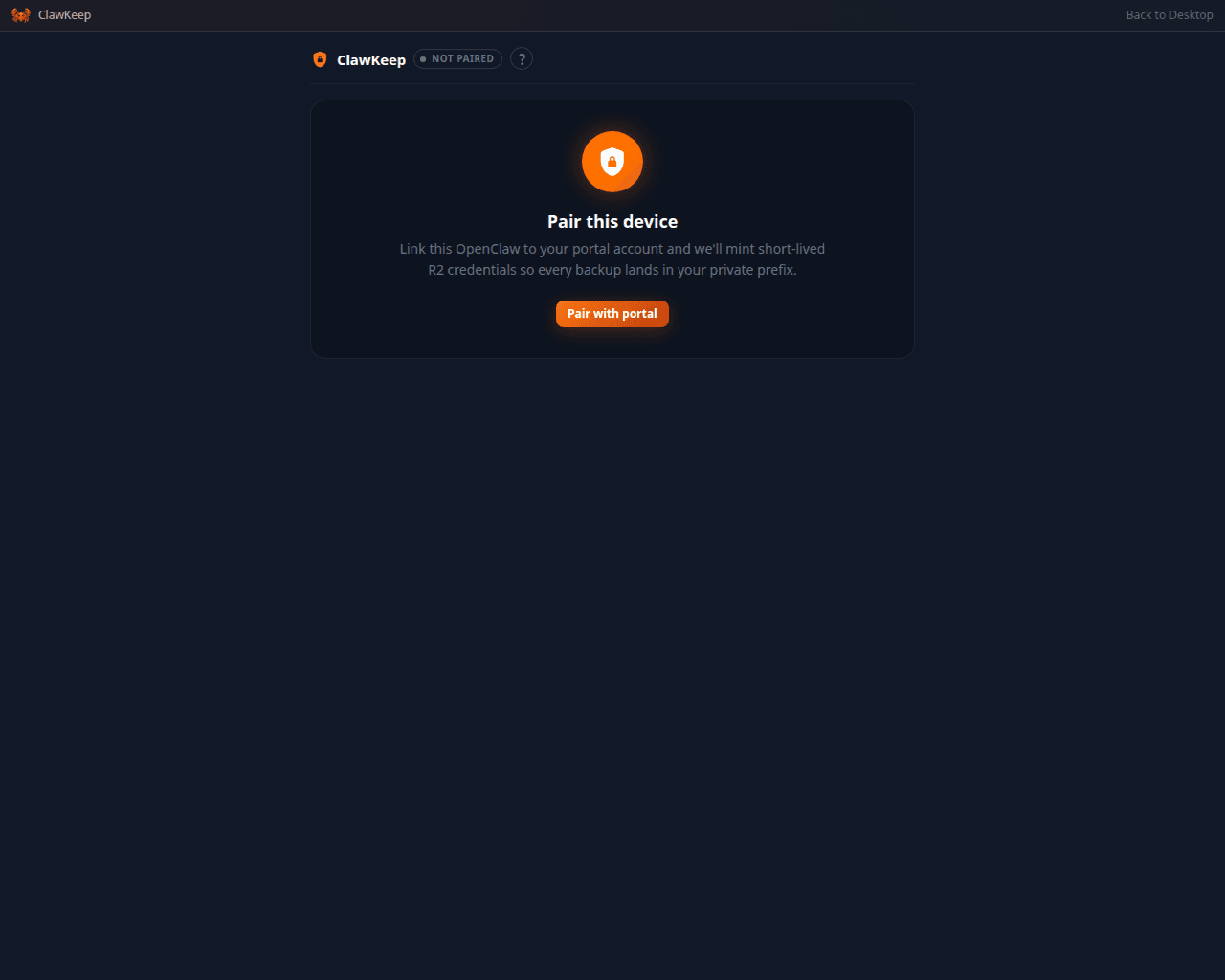
ClawKeep before it is paired: one button links the box to your account
The chat opens first on a phone
On a phone the box opens the chat, not the desktop: below 768 pixels wide, the chat is the landing surface, with a thumb-sized microphone, a composer that fits a portrait screen, and a Back button that walks up one level at a time instead of dumping you at the start. An installed home-screen app with a touch pointer gets the same treatment.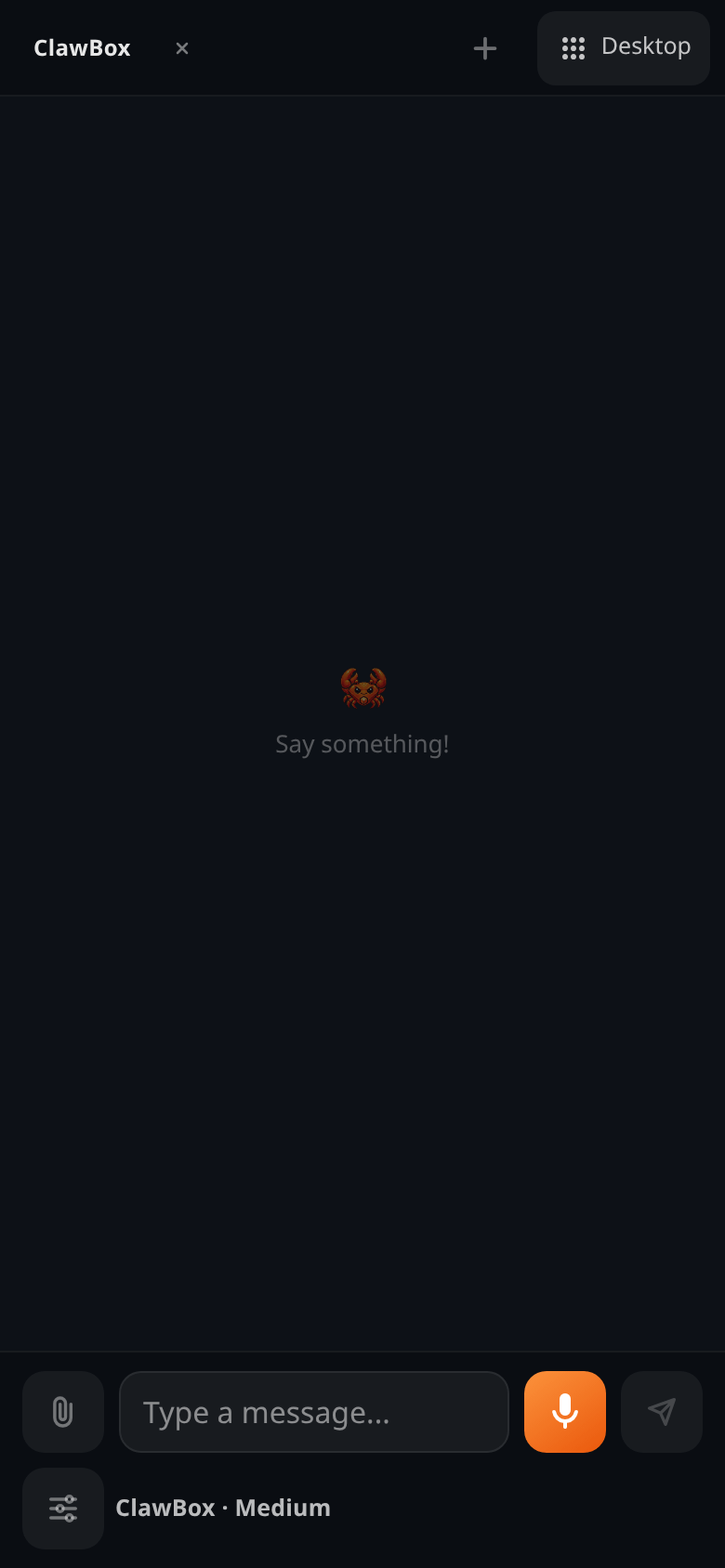
The chat in portrait: one composer row, with the pills folded behind a single control
Gemma 4 E2B runs on the box
The on-device agent model is Gemma 4 E2B Q4/INT4, Google’s own quantisation-aware release, running under llama.cpp. It is a 3.1 GB download and holds about 3.3 GB of memory on an 8 GB Jetson, which leaves room for the rest of the box to work. Install it from Settings → Local AI. See Local AI.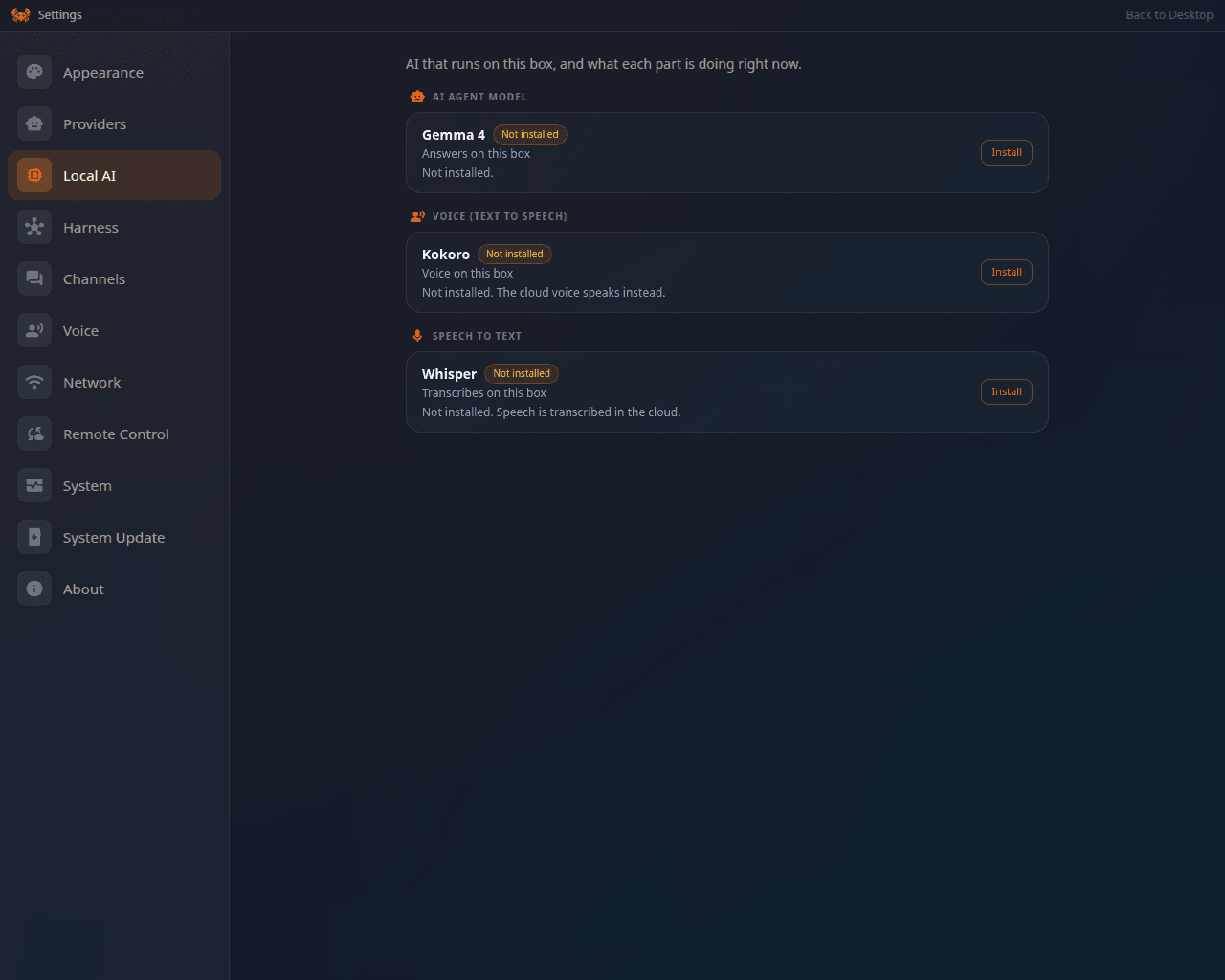
Settings → Local AI: every model that can run on the box, and what each one is doing
Change model without restarting anything
Provider, model and reasoning effort are three pills beneath the chat panel’s message box. Picking a different one applies to the running agent: nothing is restarted and there is no 30-second reconnect between you and the next message. See Chat.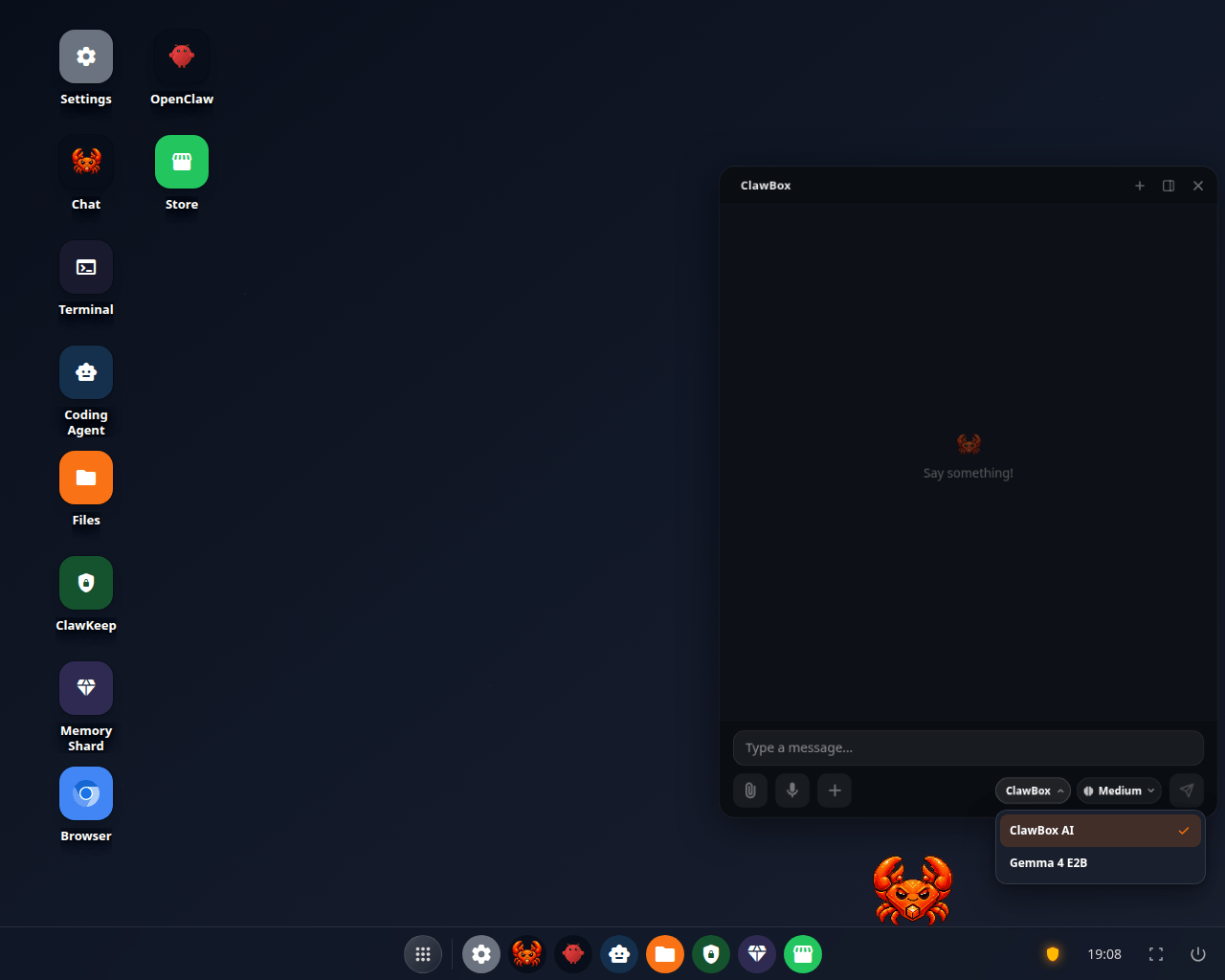
The provider pill open: switching to the on-device model without restarting the agent
A failed message tells you what the provider said
When a turn fails, the chat now prints the provider’s own reason instead of a generic “the run failed”. When a fallback model answered in place of your first choice, the reply says which model wrote it.Slash commands with autocomplete
Type/ in the chat composer and the commands your agent actually publishes appear in a
menu, each with its own description and argument hint. The list comes from the agent
itself, so it includes the commands your skills and plugins added. Both editions.
The assistant can ask you a question
When the agent needs a decision, it shows a card with the options it is choosing between, each with the consequence spelled out, plus a box for an answer of your own. Nothing happens until you send one.Spoken replies
The chat can read a reply out loud, with a player on the bubble and a scrubber. It is off by default: turn it on in Settings → Voice → Spoken replies. A box on the Max plan speaks with the ClawBox AI cloud voice; any box can install a voice of its own.ClawBox AI: usage, credits and plans in one card
Settings → Providers now shows your weekly chat allowance, the 5-hour burst window, the images, speech and memory-indexing meters, and your credit balance, read from your account rather than guessed on the device. See ClawBox AI.Voice, transcription and memory indexing use your plan’s cloud
On a box connected to ClawBox AI, on every edition, speech-to-text, text-to-speech and the memory index default to the cloud your plan covers instead of running engines on the box. The engines on the box stay the fallback, and stay selectable. A choice you make yourself is never overwritten. See ClawBox AI → What your plan powers.Nothing heavy is installed behind your back
A fresh install and every update now install only the local AI runtime and the small on-device model. The voice engine, the transcription engine and the 640 MB embedding model are installed when you ask for them, from Settings → Local AI or from Memory Shard’s own setup. Updates got much shorter as a result. See Local AI.Local AI is one inventory
Settings → Local AI lists every model that can run on the box, the agent model, the voice, speech-to-text and memory search, with Install, Uninstall, Enable and Disable on each row and what each one is doing right now. On the OpenClaw and dual editions, once the box’s own model is primary or fallback, a Local-only mode switch appears there and routes everything to the box, switching every cloud provider off. The Hermes edition has no equivalent.A Hermes plugin you install now reaches the chat
Hermes looks for plugins once, when the assistant starts, so a plugin installed or enabled after that was invisible to every chat, new conversations included, however healthy it looked from the command line. The box now handles it: when your plugins change, the assistant restarts itself so it picks them up, and the desktop shows a notice naming the plugin and telling you to open a new chat. The assistant can ask for the same restart itself, right after it installs something for you. The restart closes the chat window you have open. That is what the notice is for: open a new chat and the plugin is there. Hermes edition. See Hermes Edition.Memory Shard on both editions, and the cloud index by default
Memory Shard turns your notes, your past conversations and folders of your own documents into an index the assistant can search. It works on the Hermes edition too, and its settings let you choose where the index is embedded: the ClawBox AI cloud, or the model on the box. Since this release the cloud is the default on every edition wherever your plan covers it. A Pro or Max box that is connected indexes there without choosing anything, so there is no 640 MB model to download before your first index. On this box is the opt-in and is never overridden once you pick it, and a box that could not reach the cloud moves there by itself, with the rebuild that move needs, once a plan that covers it is linked. Memory Shard needs a Pro or Max plan. See Memory Shard.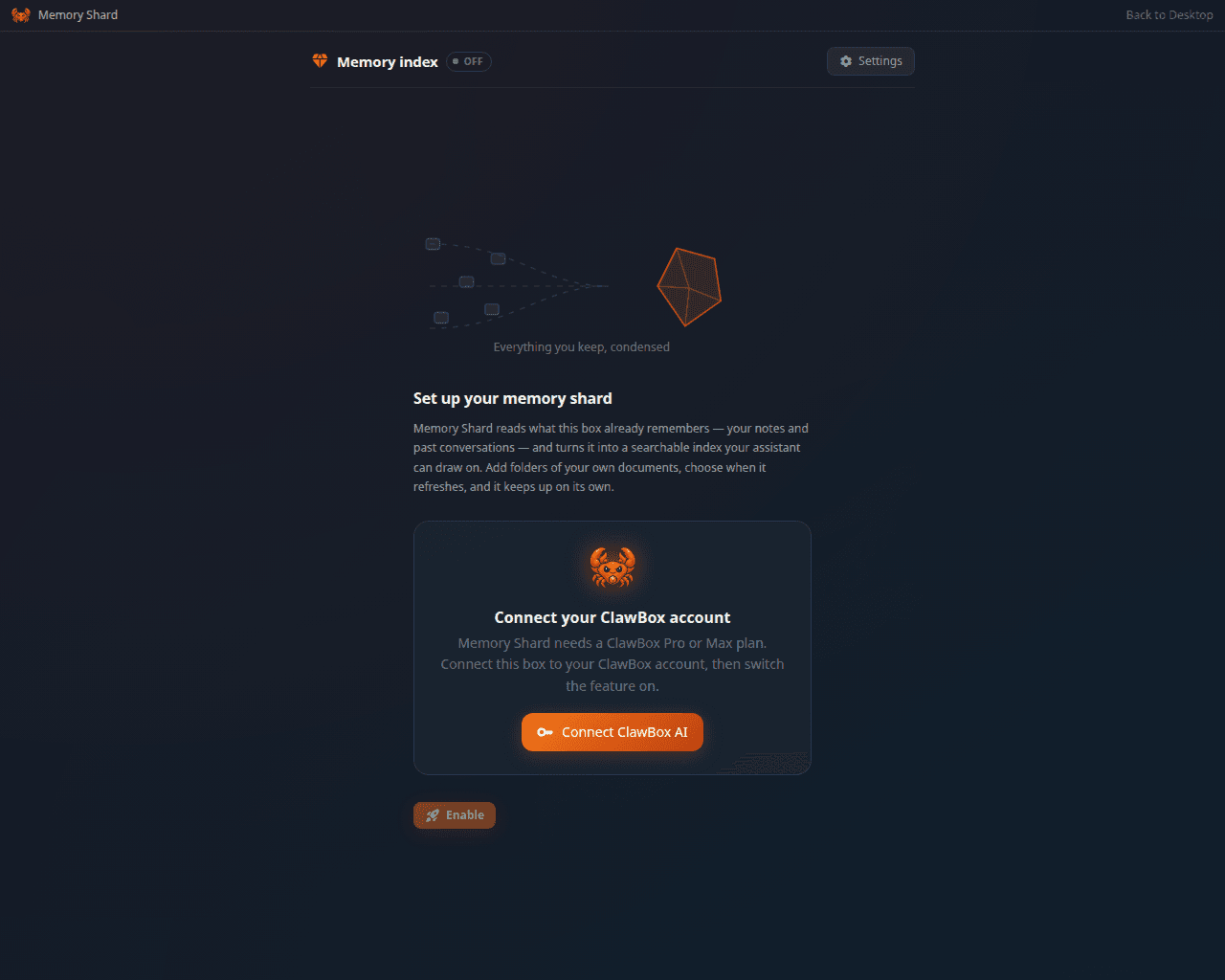
Memory Shard before its first index is built
Discord: paste the token, and that is all
Settings → Channels → Discord now reads your application id and your servers from Discord itself, builds the invite link on the box, and gives the server owner access as soon as the bot joins. There is no Application ID field to fill in any more, and no need to tell the assistant your user id. See Messaging channels.Sign in with a subscription you already pay for
Besides API keys, the provider step takes Claude Pro/Max, ChatGPT Plus/Pro and Google One AI Premium sign-ins. On the Hermes edition, Anthropic and GitHub Copilot sign in from the panel again, with the link and the code shown on screen.Pick your desktop companion
Settings → Appearance → Mascot Pet offers the ClawBox crab, which ships with the box and works offline, plus a gallery of community pets that download when you pick one. Every edition. See Desktop & appearance.Installing on your own x64 machine
install-x64.sh checks the host before it changes anything: ports already in use,
services it would replace, desktop services it would take over, and it lets you choose
the web, gateway and terminal ports. It can leave existing desktop services alone.
Smaller things
- ClawBox AI chat has no model to choose, so it names the provider and shows no model pill beside it. Its reasoning control starts at Medium.
- A sign-in that restarts the agent now re-points the chats you already have open, so an open conversation cannot keep running on the old model while the pills name the new one.
- The assistant’s own tools grew: it can read and send email you have approved, generate pictures and audio, drive the coding agent, and search Memory Shard on the Hermes edition. See Agent Interface.
- A box reached on a name that is not its own is refused on port 80, which closes a DNS-rebinding gap.
- An update that dies half way through now resumes instead of leaving the box in a state nobody can describe.